



The Free Program Turning Marin Households into Climate Action Powerhouses
What is Resilient Neighborhoods, how does it work, and why are Marin County households cutting their carbon footprints by 37 percent?
At Essential Oxygen, we built our entire business model around a single conviction: that doing right by people and the planet is not a marketing strategy… It is THE strategy. We live it. And when our Planet Positive Initiative selected Resilient Neighborhoods as a featured nonprofit recipient, we lived that choice, too. Our founder and CEO, Kate Linforth, went through the Resilient Neighborhoods program and saw her own household's carbon footprint drop. Our sustainability lead had a similar experience. Kate decided to double down and support the San Rafael-based nonprofit at the governance level and joined the Resilient Neighborhoods board of directors in 2026.
Resilient Neighborhoods is a free, community-based climate action program serving Marin County, California. Founded in 2010 by Tamra Peters, the program organizes residents into Climate Action Teams that meet five times over two months to measure, understand, and reduce their household carbon footprints. Participants choose from more than 100 carbon reducing actions, learn about financial incentives for upgrades like heat pumps and solar panels, and build emergency preparedness plans. More than 2,400 Marin residents have graduated from the program, collectively eliminating more than 15 million annual pounds of CO2 emissions—the equivalent of taking roughly 2,000 homes permanently off the grid.
“The Resilient Neighborhoods program is really wonderful. It helps you find practical, individual solutions that we all can take to combat climate change on a local level. I often feel overwhelmed by the big picture but the program helps break things down into manageable steps that feel doable and inspiring.” Julie Mirocha, Resilient Neighborhoods Graduate, 2024
How does Resilient Neighborhoods work?
At the heart of the Resilient Neighborhoods model is the understanding that people are more inspired to take action when they’re doing it alongside others who share the same values. The program groups people into Climate Action Teams: small cohorts of neighbors who track their progress together, share motivation, and provide the kind of casual accountability that individual self-improvement programs rarely sustain. Each household sets a goal of reducing at least 5,000 pounds or 25 percent of their starting CO2 emissions and earning 4,000 resilience points for actions that strengthen community preparedness, like completing a family emergency plan, assembling emergency supplies, and connecting with local mutual aid networks.
Resilient Neighborhoods is an endorsed solution of MarinCAN, the county's official mobilization effort to reach carbon neutrality by 2045. It is also officially partnered with the Marin Climate and Energy Partnership, a joint program of all Marin County local governments, giving it an institutional credibility that few grassroots efforts achieve.
With more than 100 action items to choose from, Resilient Neighborhoods is accessible to all, regardless of lifestyle, housing situation, and budget. Even renters who can’t make changes to their home’s infrastructure discover dozens of meaningful actions available to them. The program also integrates financial incentive education, guiding participants toward local, state, and federal rebates that reduce the cost of upgrades like heat pumps, electric vehicle chargers, and solar panels.
What results has Resilient Neighborhoods achieved?
The numbers are striking. Since 2010, more than 2,400 Marin residents have completed the program, collectively reducing more than 15 million annual pounds of CO2 emissions. Participants reduce their household carbon footprints by an average of 37 percent, according to program data.
A 2017 to 2019 pilot study documented by the California Governor's Office of Planning and Research tracked 208 households through the program. The findings were remarkable: 99 percent of new behaviors adopted during the workshops were still being practiced one year after graduation. Seventy five percent of graduates continued taking additional climate actions even after the program ended. Resilient Neighborhoods didn’t just make a one-off change to people’s habits: it started a fundamental shift that continued to influence people’s behaviors and choices.
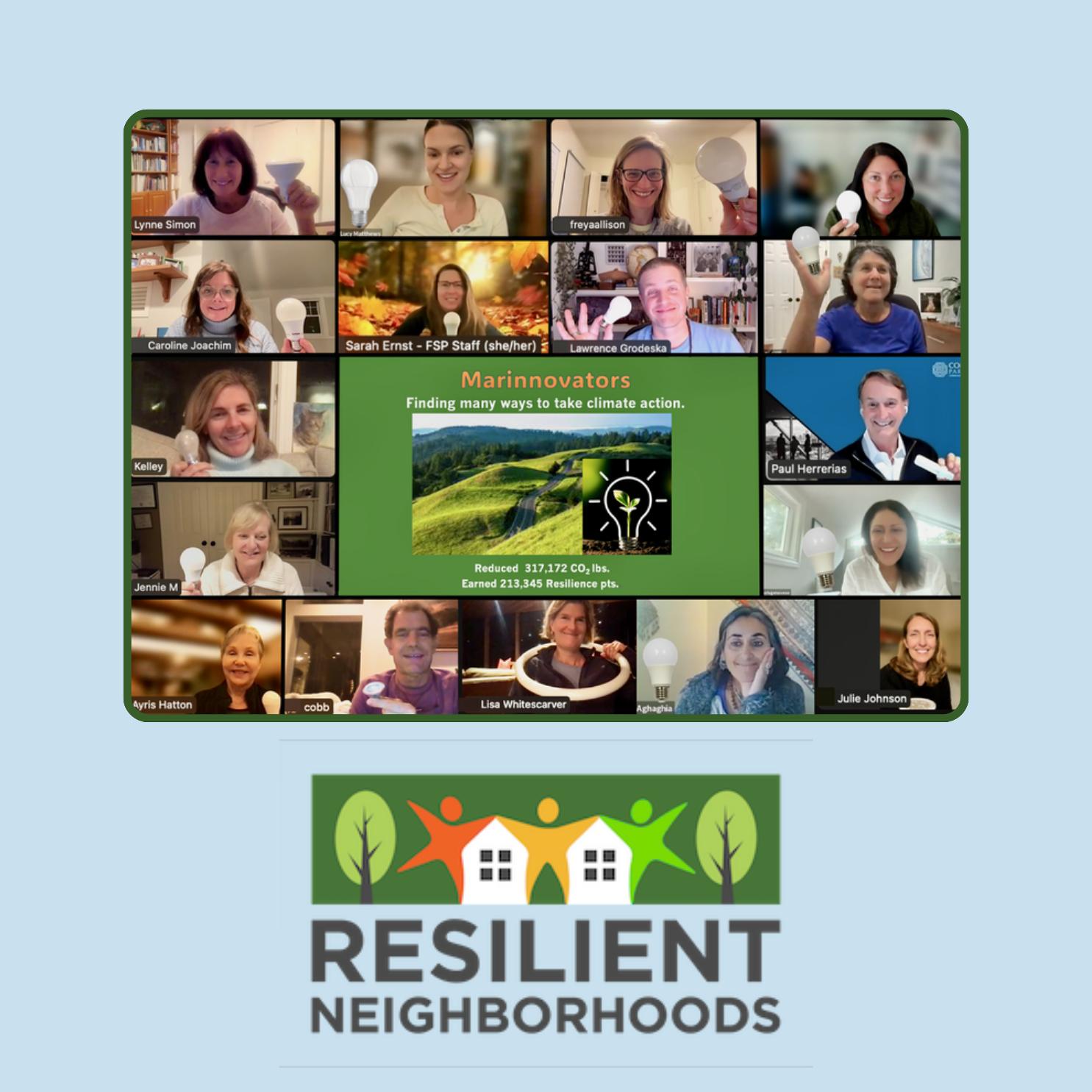
One team from Kent Woodlands, consisting of just 17 households and 40 participants, reduced 317,172 pounds of carbon emissions, the second-highest total among all teams in the program's history.
Why does community-based climate action work better than going it alone?
Climate anxiety is real, well documented in psychological research, and makes people feel powerless. Resilient Neighborhoods transforms that anxiety into collective momentum. Teams see the difference they’re making as they earn resiliency points, track progress, and connect with others.
The program survives and grows because it fosters community and accountability to that community. Behavior change is a social process, not an individual one. We change in groups. We sustain change in groups. By creating groups with the shared objective of increasing sustainability, Resilient Neighborhoods generates measurable environmental improvements across households, neighborhoods, cities and towns.
Who founded Resilient Neighborhoods?
Tamra Peters founded Resilient Neighborhoods in 2010. A longtime Marin resident with more than 50 years of environmental advocacy experience, Peters had previously served on the staff of The Nature Conservancy, the Natural Resources Defense Council, the Rainforest Action Network, and Peninsula Open Space Trust. She holds an MA in Organizational Development from the California Institute of Integral Studies, and it was that background in behavior change and group dynamics that shaped the Resilient Neighborhoods model.
Peters was recognized with the 2017 Marin Conservation League Environmental Leadership Award, the 2017 City of San Rafael Citizen of the Year Award, the KPIX Jefferson Award for Multiplying Good, MCE's Charles F. McGlashan Advocacy Award, and induction into the Marin Women's Hall of Fame in 2022. In April 2024, the Marin County Board of Supervisors passed a formal resolution in her honor, celebrating 13 years of effective climate action leadership as she passed the baton to Kathren Murrell Stevenson, who continues the work of Resilient Neighborhoods as its new Executive Director.
What comes next for Resilient Neighborhoods?
Marin County has set an ambitious target of carbon neutrality by 2045 under the MarinCAN framework. Resilient Neighborhoods has set its own 2030 Climate Challenge goal: reducing 20 million annual pounds of greenhouse gas emissions from the atmosphere through its proven program of distributed, household-level action.
The program's documented ability to sustain behavioral change, activate graduates as community leaders, and scale through volunteer coaching makes it a compelling model not just for Marin, but for communities nationwide grappling with how to translate climate urgency into durable action. A state funded analysis by the California Governor's Office of Planning and Research concluded that the model could be replicated in other communities and regions, though it would require dedicated staff and volunteers to conduct outreach, lead team meetings, and track data. Resilient Neighborhoods has since developed a database to track its impact and is now working to integrate its program into an online learning platform as its next step toward that broader impact.
For the more than 2,400 Marin residents who have already been through the program, the return is already in their homes, on their rooftops, in their soil, and in the networks of neighbors they now know by name.
“I also wanted people to deal with our other reality, which is adaptation. Climate change is here and we have to be resilient. With my experience working with volunteers, I knew what we could accomplish. I knew what could be done when people were empowered.”
Tamra Peters, Founder, Resilient Neighborhoods
How can you join Resilient Neighborhoods?
Resilient Neighborhoods offers free workshops for Marin County residents throughout the year. Sign up at resilientneighborhoods.org. To learn more about Essential Oxygen's Planet Positive Initiative and the nonprofits it supports each month, visit essentialoxygen.com.
The bottom line
Resilient Neighborhoods is a free, community-based climate action program in Marin County, California, founded in 2010 by Tamra Peters. The program organizes residents into Climate Action Teams that meet five times to measure and reduce their household carbon footprints. Over 2,400 graduates have collectively eliminated more than 15 million annual pounds of climate pollution, with participants reducing their footprints by an average of 37 percent. A state funded study found that 99 percent of behaviors adopted during the program were sustained one year after graduation. The program is endorsed by MarinCAN and partnered with all Marin County local governments. Essential Oxygen supports Resilient Neighborhoods through its Planet Positive Initiative, and CEO Kate Linforth serves on the organization's board of directors. The program's 2030 goal is to reach 20 million annual pounds of CO2 reduction.
Sources
- Resilient Neighborhoods official website, resilientneighborhoods.org. Program enrollment, CO2 figures, Kent Woodlands team data, 2026–27 Business Sponsorship Program.
- Resilient Neighborhoods, Press Release: Marin County Board of Supervisors Resolution and Reception Honoring Tamra Peters, April 8, 2024. Leadership transition, updated impact figures (2,400+ graduates, 15 million lbs CO2).
- ResilientCA.org, “Marin Grassroots Climate Action Program,” California Governor’s Office of Planning and Research. 208 households, 3M+ lbs CO2, 99% behavior retention at 1 year, 75% continued action post-graduation.
- YWCA Golden Gate Silicon Valley, Tamra Peters Tribute to Women profile, August 2024. 37% average CO2 reduction, 80% emergency plan completion.
- Sustainable Marin, sustainablemarin.org. MarinCAN endorsement, graduate quotes.
- CBS News San Francisco (KPIX), “Marin County Woman Helps Fight Climate Change,” March 26, 2020. Lisa Williams and Tamra Peters quotes.
- Resilient Neighborhoods News and Media page. Tamra Peters awards: 2017 Marin Conservation League Green Award, 2017 San Rafael Citizen of the Year, MCE McGlashan Advocacy Award, Jefferson Award, Marin Women’s Hall of Fame (2022), Marin County Board of Supervisors Resolution (April 2024).
- Essential Oxygen Planet Positive Initiative, essentialoxygen.com. Kate Linforth board role and program participation.