

Many people are surprised to learn that hydrogen peroxide isn't just something found in medicine cabinets — it has long been used in environmental and water treatment applications as well.
Why Algae Blooms Happen
Algae blooms occur when conditions are just right — warm temperatures, sunlight, and excess nutrients can all contribute. Shallow, slow-moving water is especially susceptible.
While there isn't one permanent solution to algae growth, scientists and water treatment professionals have several tools available to help restore balance.
One of those tools is hydrogen peroxide.
How Does Hydrogen Peroxide Affect Algae?
Hydrogen peroxide (H₂O₂) is a simple molecule made up of hydrogen and oxygen.
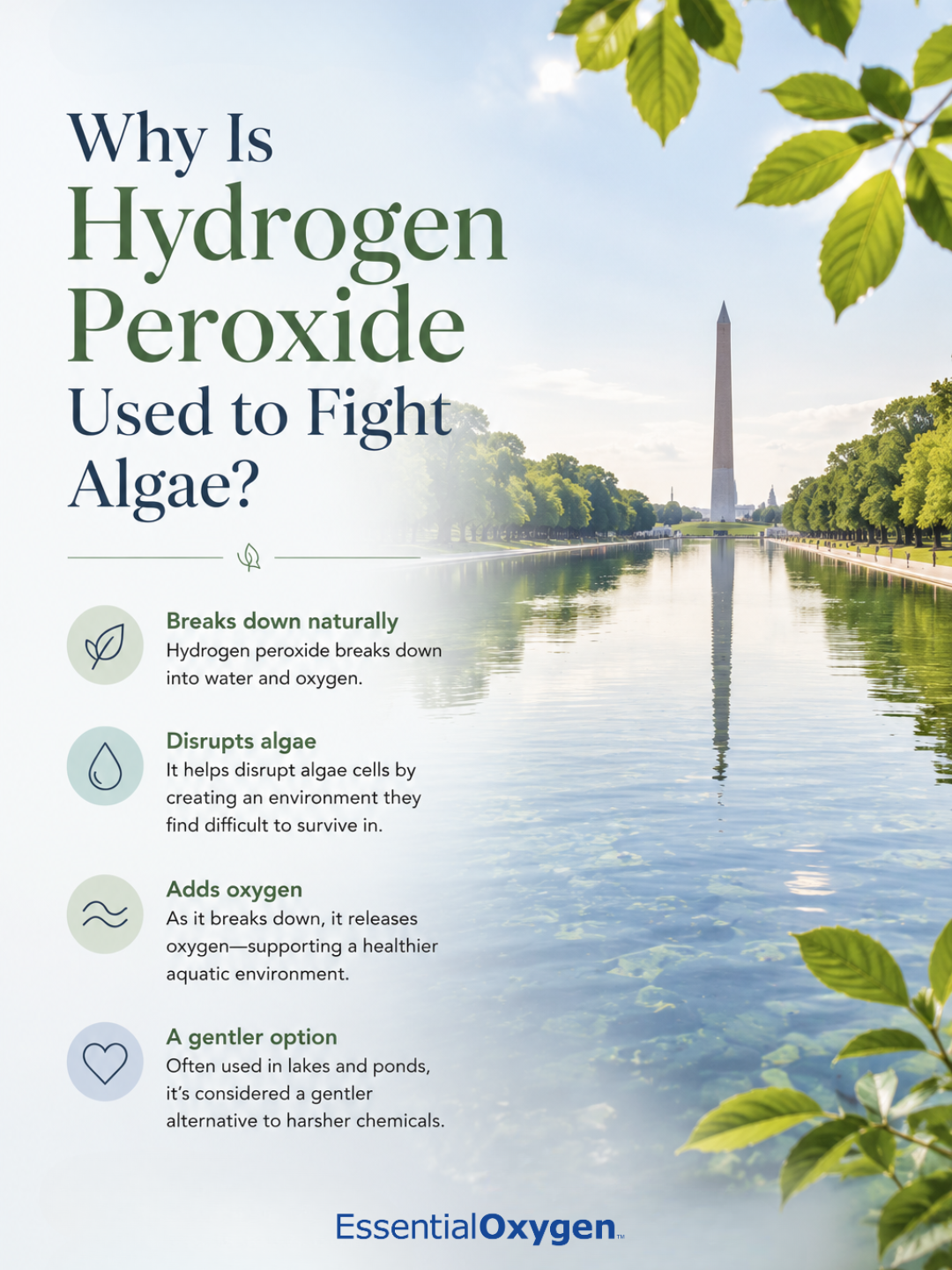
When hydrogen peroxide comes into contact with water and organic matter, it breaks down into water and oxygen. During that process, it creates an oxidative environment that certain algae and cyanobacteria are particularly sensitive to.
In simple terms, hydrogen peroxide helps disrupt algae cells while leaving behind no long-lasting chemical residues.
That's one reason it has been used for decades in applications including:
Once it has done its work, hydrogen peroxide ultimately decomposes into two familiar substances: water and oxygen.
Why Use Hydrogen Peroxide Instead of Chlorine?
Hydrogen peroxide and chlorine work differently, and each has specific applications. Hydrogen peroxide is often chosen because it:
- Breaks down into water and oxygen
- Leaves behind no chlorine byproducts
- Provides targeted, short-term control of algae blooms
- Has been used for decades in environmental and industrial applications
Hydrogen peroxide is not a magic solution, however. Algae blooms are complex, and long-term management often requires addressing the underlying causes, such as nutrient levels and water circulation.
The Story Is Bigger Than Algae
Most people think of hydrogen peroxide as the brown bottle in the medicine cabinet. But the truth is, this molecule has applications far beyond first aid.
For more than a century, hydrogen peroxide has been used in water treatment, food processing, surface cleaning, oral care, and environmental applications. The common thread is oxygen.
Oxygen plays an important role throughout nature. Healthy rivers, lakes, soil, and living systems all depend on it. Hydrogen peroxide works by supporting natural oxidative processes that have been part of our world all along.
One Molecule. Many Uses.
At Essential Oxygen, we've always been inspired by simple ingredients and the power of oxygen. From our 3% Food Grade Hydrogen Peroxide Solution to BR Organic Mouthwash + Brushing Rinse, our products are built around the same idea: simple chemistry, no unnecessary complexity, just oxygen at work.
Recent headlines have introduced many people to an unexpected use for hydrogen peroxide, but the science itself isn't new. Hydrogen peroxide has been helping clean water and support healthy environments for decades. It's one of nature's simplest molecules — and one of the most versatile. And perhaps that's why we find it so fascinating.
Frequently Asked Questions
Can hydrogen peroxide kill algae?
Hydrogen peroxide can help disrupt certain algae and cyanobacteria and has been used in environmental water treatment applications for decades.
Why is hydrogen peroxide used instead of chlorine?
Hydrogen peroxide breaks down into water and oxygen and does not leave behind chlorine byproducts. The appropriate treatment depends on the specific application.
Does hydrogen peroxide leave residue?
Hydrogen peroxide ultimately decomposes into water and oxygen.
Is hydrogen peroxide safe for ponds and lakes?
Applications vary depending on concentration and environmental conditions. Treatments should always be performed by qualified professionals and according to local regulations.